
Patient engagement software: a buyer's guide for regenerative medicine clinics
Patient engagement software for regenerative medicine clinics: the must-have features, HIPAA checks, and a scoring table to compare vendors before you buy.

Patient engagement software is the system a clinic uses to keep patients informed, replying, and moving forward from first inquiry to follow-up. For regenerative medicine clinics, good patient engagement software puts every channel on one patient record, replies fast after hours, and supports long, multi-visit journeys. The right choice depends less on the feature list and more on how well it fits your patient journey.
This guide is for clinic owners and patient advocate leads comparing tools. It covers the features that matter, HIPAA checks, a scoring table for demos, and how to measure results.
What is patient engagement software?
Patient engagement software is any tool that helps your team communicate with patients and keep them involved in their care, between visits as well as during them.
Most products bundle some mix of these features:
- Two-way messaging by text, email, and chat apps
- Appointment reminders and confirmations
- Online intake forms and document upload
- Self-scheduling and rescheduling
- A branded, secure place where patients see their plan and next steps
- Surveys, check-ins, and review requests after care
Patients already expect this. In a national survey, the Office of the National Coordinator for Health IT found that about 73 percent of US adults were offered online access to their records in 2022, and 57 percent used it at least once. People who used an app accessed their information more often than people who did not.
Engagement also shapes the care experience. A widely cited Health Affairs review found that patients who are more engaged in their own care tend to report better care experiences. Software removes the friction that makes patients go quiet.
What should patient engagement software do for a regenerative medicine clinic?
It should support a long journey with many handoffs, not just a single appointment.
Most patient engagement software is built for primary care: a short visit, a reminder, and a survey. Regenerative medicine clinics run a different journey. Patients research for weeks, compare clinics, talk with family, and may travel for treatment.
| Stage | What the patient needs | What the software should do |
|---|---|---|
| Inquiry | A fast, personal reply | Answer on the channel they used, day or night, and log it on one record |
| Consult | Clear expectations | Book, confirm, collect intake and records before the call |
| Decision | Time and trust | Send a clear plan and next steps, then nurture without spamming |
| Preparation | Practical details | Share prep instructions, travel and lodging details, and a named contact |
| Treatment | Reassurance | Track multi-visit schedules and send day-of details |
| Follow-up | Ongoing contact | Run check-ins on a set schedule and flag patients who need a call |
| Referral | An easy way to share | Ask for reviews and referrals at the right moment |
Clinic teams describe the same gaps again and again. Conversations live in a personal WhatsApp, a shared inbox, and a spreadsheet at once. Multi-visit protocols get tracked by hand. Follow-ups sit in a spreadsheet one person owns, and when that person is out, patients wait.
If you want to see how speed and follow-up shape attendance, our guide on how to reduce patient no-shows covers the confirmation cadence in detail.
Which patient engagement software features matter most?
The features that matter most are the ones that keep one shared view of the patient and make it easy for the patient to reply.
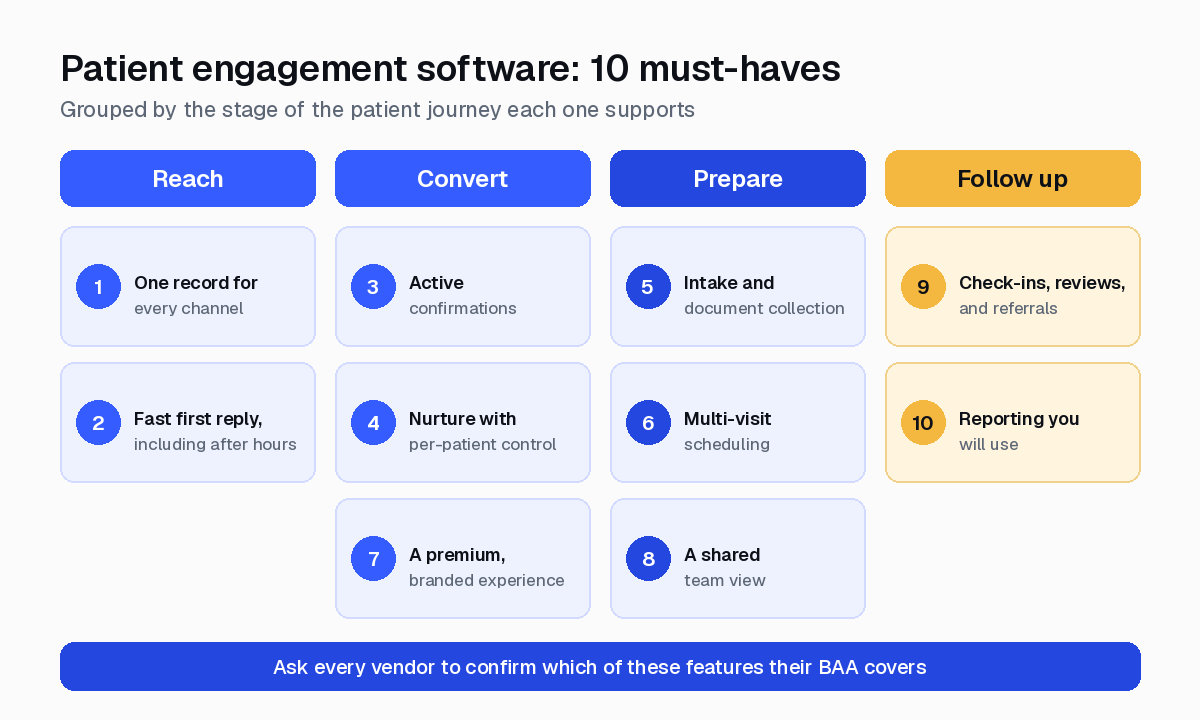
Use this checklist when you build your shortlist:
- One record for every channel. Phone, text, WhatsApp, email, website chat, and social messages should land on the same patient record. If your team copies messages between tools, details get lost.
- Fast first reply, including after hours. Interest fades quickly. Research on online leads in the Harvard Business Review found that the odds of reaching and qualifying a lead drop sharply when a business waits to respond.
- Active confirmations. Reminders should ask for a reply, and non-replies should create a task for a person. A Cochrane review found attendance of about 79 percent with text reminders compared with about 68 percent with no reminder.
- Nurture with control. Long decision cycles need a sequence of useful messages. Your team must be able to pause, edit, or stop it per patient. Patients who feel blasted with texts opt out, and then you cannot reach them at all.
- Intake and document collection. Capture basic contact details first and send the detailed medical questionnaire before the consult. Patients should upload imaging and records in one secure place.
- Multi-visit scheduling. Protocols with several visits need a schedule the patient can see, with reminders for each step.
- A premium, branded experience. A branded link where the patient can meet the team, see the plan, and find travel details makes a high-ticket protocol feel personal before they ever arrive.
- A shared team view. Advocates, coordinators, and doctors may work different hours or sit in different countries. Everyone should see the full history and the next step.
- Follow-up and reviews. Scheduled check-ins after treatment, with alerts when a patient does not respond, plus timed review and referral requests.
- Reporting you will use. Response time, reply rate, confirmation rate, and conversion by lead source.
For a deeper look at what to ask about data and access, read our HIPAA compliance checklist for clinic software.
How do you keep patient engagement HIPAA compliant?
You keep engagement HIPAA compliant by signing a BAA with every vendor that handles patient information and by sending only the detail each message needs.
HHS guidance on business associates names app developers that provide patient messaging or scheduling on behalf of a provider as examples of business associates. That means a BAA is required before patient information flows through their system.
Check these points with every vendor:
- BAA scope. Ask which features and channels the BAA covers. A BAA that covers the database but not the texting or chat feature leaves a gap.
- Third-party channels. If the software sends through WhatsApp, a texting provider, or an email service, ask how each one is covered.
- Access controls and audit logs. Each team member should see only what their role needs, and every view should be logged.
- Message content. HHS says providers may email patients with reasonable safeguards, such as limiting what an unencrypted message includes. Keep reminders to the clinic name, date, and time.
- Patient preferences. Patients may ask to be contacted by a different method. Your software should record that preference and follow it.
How do you evaluate patient engagement software?
Evaluate patient engagement software by scoring each vendor against your own patient journey, using the same scenarios in every demo.
Before demos, write down three real scenarios: a patient who messages at 11pm on WhatsApp, one who goes quiet after the consult, and one who flies in for a multi-day visit. Ask each vendor to walk through all three live.
Then score each one:
| Criteria | Weight | Questions to ask |
|---|---|---|
| Channel coverage on one record | 20% | Do all channels land on the same patient record, including WhatsApp and social? |
| Speed of first reply | 15% | What happens to an inquiry at night or on a weekend? |
| Journey fit | 15% | Can it handle long decision cycles, multi-visit schedules, and travel details? |
| HIPAA and BAA scope | 15% | Which features does the BAA cover, and how are access and logs handled? |
| Patient experience | 10% | Is it branded, mobile-friendly, and easy to reply to without a login? |
| Team adoption | 10% | How long until coordinators use it daily? What training is included? |
| Integrations | 10% | Does it work with your scheduling, records, and payment tools? |
| Reporting | 5% | Can you see reply rates and conversion by lead source? |
Score each line from 1 to 5, multiply by the weight, and add it up. Adjust the weights if, for example, most of your patients travel for treatment.
How is patient engagement software different from an EHR or practice management system?
An EHR holds the clinical chart, a practice management system runs scheduling and billing, and patient engagement software manages the conversations around both.
| Tool | Main job | Where it falls short for engagement |
|---|---|---|
| EHR | Clinical documentation, orders, charts | Patient messaging is often basic and tied to a login |
| Practice management | Scheduling, billing, claims | Built around appointments, not long decision cycles |
| General marketing tools | Email campaigns, ads, landing pages | Not built for health information or a BAA |
| Patient engagement software | Messaging, reminders, intake, follow-up | Needs to connect to your clinical and scheduling tools |
Most clinics need more than one of these. The goal is one place for each patient conversation. If marketing is your main gap, our guide to regenerative medicine marketing covers how to bring in the right inquiries first.
How do you measure patient engagement?
Measure patient engagement with behaviors you can count, then review them monthly by lead source and appointment type.
| Metric | What it tells you |
|---|---|
| Time to first reply | Whether new inquiries hear back while they are still interested |
| Reply rate | Whether your messages are useful enough to answer |
| Confirmation rate | Whether your reminder cadence works |
| No-show rate | Whether patients arrive prepared and committed |
| Intake completed before the visit | Whether preparation steps are clear |
| Check-in completion after treatment | Whether follow-up is reaching patients |
| Reviews and referrals | Whether patients would recommend you |
Set a baseline before you switch tools. Our no-show guide shows a simple way to track misses by lead time.
What mistakes do clinics make when buying patient engagement software?
The most common mistake is buying for features instead of fixing the journey the patient actually experiences.
Watch for these:
- Adding another inbox. A new tool that does not replace the WhatsApp threads and spreadsheets just adds one more place to check.
- Automating too much, too soon. Start with confirmations and a short nurture sequence. Add more once your team trusts it.
- Forgetting the team. If coordinators find it slow, they go back to their phones.
- Skipping the BAA review. Confirm coverage before any patient data goes in.
- Never measuring. Without a baseline you cannot tell whether the software helped.
Where Caddie fits
Caddie is the AI operating system for regenerative medicine clinics. It is built only for regenerative medicine clinics and runs the full patient journey on one platform, from inquiry and conversion to preparation, treatment logistics, follow-up, and referrals.
If you are comparing patient engagement software, here is how Caddie maps to the checklist above:
- Mia, your AI Patient Coordinator. Mia answers inquiries right away, 24/7, on the channel the patient already uses, books consults, and follows up, so your team spends its time on patients instead of chasing replies. Across ResCore, Optimal Health, and CMF Surgeons, average speed-to-lead moved from 1.5 days to 5 minutes, and conversion improved 71% on average.
- One patient record. Every message, call, and booking lives in one place, with unlimited users. 25+ hours a week saved in combined admin and physician time, across ResCore, Chapala Med, and Renue.
- Patient Portal (beta). A branded portal where patients see their plan, upload records, and get visit and travel details. Across 3 clinics using the Patient Portal, patient referrals up 25% and reviews and testimonials up 75%.
- HIPAA compliant, with a BAA. Patient data is encrypted, access logged, and your data is never used to train AI models.
Our team handles about 95% of setup, with about 1 hour a week from your team, and clinics go live in about 6 weeks.
Frequently asked questions
What is patient engagement software?
Patient engagement software is the set of tools a clinic uses to communicate with patients and keep them involved in their care. It usually covers messaging, reminders, intake forms, document sharing, self-scheduling, and follow-up surveys. The best systems keep every conversation tied to one patient record so any team member can pick up where the last one left off.
Is patient engagement software the same as a portal?
No. A portal is one feature. Patient engagement software also includes two-way messaging, reminders, nurture sequences, intake, and follow-up. Many patients will not log in to a portal often, so the software also has to reach them by text, email, or chat apps.
Does patient engagement software need a business associate agreement?
Yes, if the vendor creates, receives, stores, or sends protected health information for your clinic. HHS lists vendors of patient messaging and scheduling apps as examples of business associates. Ask the vendor to confirm in writing which features and channels the BAA covers.
How much does patient engagement software cost?
Pricing varies widely. Some vendors charge per provider, some per location, and some by message or lead volume. Compare the total cost of the tools it replaces, including staff time spent copying information between systems, and ask what setup and training are included.
How do you measure patient engagement?
Track behaviors you can count: time to first reply, the share of patients who reply to messages, confirmation and no-show rates, how many patients complete intake before the visit, check-in completion after treatment, and reviews and referrals. Review the numbers monthly by lead source and appointment type.
See Caddie built around your clinic
Book a free call and we’ll show you how leading regenerative clinics convert more patients with Caddie.
Book a free demo