
How to reduce patient no shows at regenerative medicine clinics
How to reduce patient no shows at regenerative medicine clinics: confirm on the patient's channel, shorten lead time, prep visits early, and refill open slots.

The fastest way to reduce patient no shows is to shorten the time between booking and the visit, ask every patient to actively confirm on the channel they already use, and give them a clear reason to show up prepared. Reminders help, but confirmation, preparation, and a fast follow-up when someone misses are what move the number. If you want to know how to reduce patient no shows at a regenerative medicine clinic, start by finding where your patients drop off.
This guide is for owners, COOs, and patient advocate leads. It covers what drives no-shows, how to build a reminder and confirmation cadence, how to handle consults for high-ticket protocols and patients who travel for treatment, and how to measure progress.
Why do patients no-show for appointments?
Patients no-show most often because too much time passes between booking and the visit, or because they have missed appointments before.
A 2018 systematic review in Health Policy looked at 105 studies and found an average no-show rate of about 23 percent, ranging from 4 percent to almost 80 percent. The two strongest predictors it identified were long lead time and a history of prior no-shows. In conversations with clinic teams, a few patterns come up again and again:
- Bookings the patient barely remembers. Appointments set by a third-party agency or an outbound campaign often show up at a much lower rate than ones booked by the clinic's own team, even when reminders go out.
- Silence after the first touch. The patient booked quickly, then stopped replying to texts and calls before the visit.
- Unclear next steps. The patient does not know what to bring, what the visit includes, or whether imaging or records are needed, so the appointment feels easy to skip.
- Logistics that fall apart. For patients who travel, a flight change, a lodging problem, or a missing companion can turn a planned visit into a quiet cancellation.
None of these are solved by one more reminder. They are solved by a process.
How do you reduce patient no shows with reminders and confirmations?
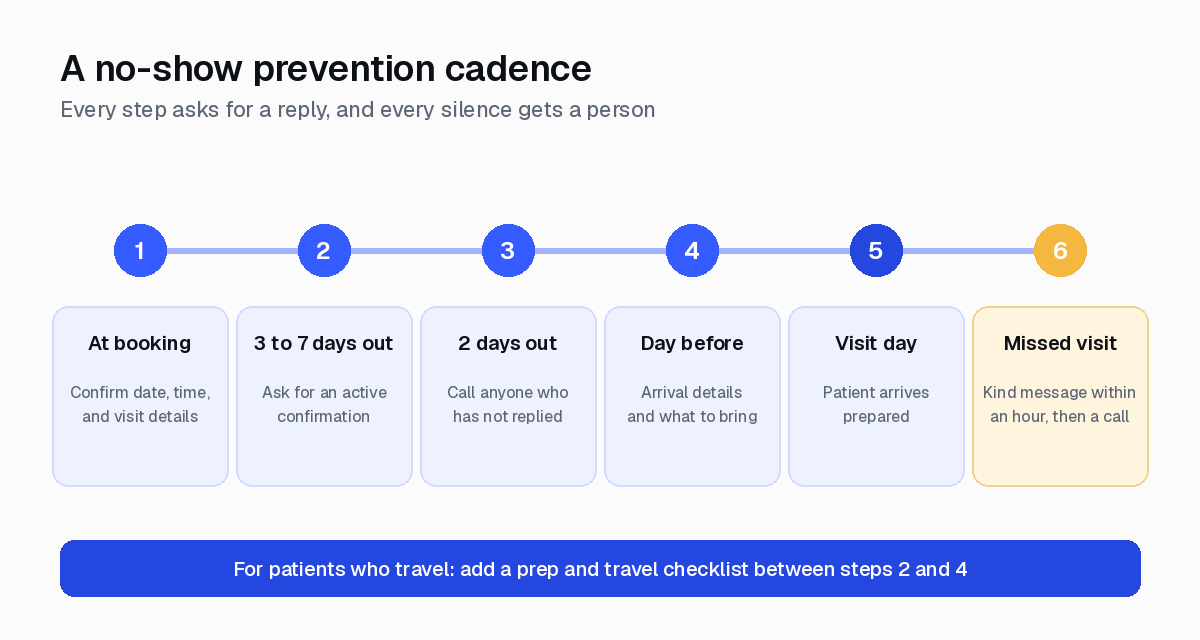
You reduce patient no shows by turning reminders into a confirmation workflow: every message asks for a reply, and every non-reply triggers a human follow-up.
The evidence for reminders is solid but modest. A Cochrane review of mobile phone messaging reminders pooled randomized trials and found attendance of about 68 percent with no reminder and about 79 percent with text reminders. Text and phone call reminders performed about the same, and text was cheaper to send. The review rated the evidence low to moderate, so treat reminders as the floor, not the whole plan.
Here is a cadence that works for most consults and visits:
| When | Channel | Purpose | What the patient should do |
|---|---|---|---|
| At booking | The channel they booked on | Confirm date, time, location, and what the visit covers | Reply to confirm and save the date |
| 3 to 7 days before | Text or chat app | Request an active confirmation | Reply YES, or pick a new time |
| 2 days before | Text, then a call if no reply | Recover non-responders | Confirm or reschedule |
| Day before | Text | Short reminder with arrival details | Arrive on time with what they need |
| 1 hour after a missed visit | Text, then a call | Same-day recovery | Book a new time |
Three details make this work:
- Use the patient's channel. If the patient wrote to you on WhatsApp or Instagram, confirm there. Some clinics run confirmations on WhatsApp with a two-day reply window, then release the slot if there is no answer.
- Make confirming easy. One-word replies and a direct link to reschedule beat a phone number to call during business hours.
- Escalate silence. A patient who does not confirm two days out should get a call from a person, not a third automated text.
Keep privacy in mind. HHS says appointment reminders are allowed without patient authorization, but messages left for patients should share only what is needed, and you must honor requests for confidential contact. A good reminder names the clinic, the date, and the time, not the condition or the procedure. Our guide to a HIPAA compliant CRM covers how to keep these messages safe across channels.
How does lead time affect no-shows?
Longer lead time raises no-show risk, so book consults as close to the inquiry as you can and fill the gap with useful contact.
The Health Policy review found lead time was one of the most consistent predictors of a missed appointment. The practical fix is speed. When an inquiry comes in, a patient who can book a consult within a few days is more likely to show than one booked three weeks out. Research on online sales leads in the Harvard Business Review found that interest fades fast when a business waits to respond, and the same logic applies to a booked consult.
When a long gap cannot be avoided, use it:
- Send a short welcome message that explains what the consult covers and who the patient will meet.
- Ask for intake forms, imaging, or records early, so the patient is invested before the visit.
- Offer an earlier slot from a cancellation list when one opens.
What should regenerative medicine clinics do differently?
Regenerative medicine clinics need a prep checklist, not just a reminder, because consults for high-ticket protocols often involve records, travel, and decisions made with family.
A generic outpatient reminder is built for a 15-minute follow-up visit. Your patients may be weighing a multi-visit plan, flying in from another state or country, or arranging time off work. Use this checklist for consults and treatment visits:
Before the consult
- Confirm the patient's goals and the questions they want answered.
- Collect intake forms, prior imaging, and relevant records.
- Share the clinic address, parking, and arrival time.
Before a treatment visit for patients who travel
- Confirm travel dates and arrival time in writing.
- Share a single page with lodging suggestions, local transport, and what to pack.
- Confirm who is coming with the patient, if anyone.
- List any pre-visit instructions from the care team in plain language.
- Name one person on your team the patient can contact.
After the patient commits
- Send a written summary of the plan and schedule.
- Explain the deposit, rescheduling, and cancellation terms.
- Set check-ins at fixed points before the visit so the patient never goes a week without hearing from you.
Patients who feel looked after are less likely to disappear. A branded, single place where they can see their plan, upload documents, and message the team makes the experience feel premium and keeps everything in one thread instead of scattered emails. For more on attracting the right patients in the first place, read our guide to regenerative medicine marketing.
Should you use deposits or no-show fees?
A written, consistent policy reduces no-shows more than the size of any fee, so decide the policy first and the amount second.
Here is how the common options compare as an operations choice:
| Policy | How it works | Best for | Watch out for |
|---|---|---|---|
| Deposit applied to care | Patient pays a deposit to hold a treatment date, credited to the plan | Treatment visits for high-ticket protocols | Must be explained clearly at the time of commitment |
| Late cancellation fee | Fee if the patient cancels inside a set window | Consults with long lead times | Can feel punitive if not stated upfront |
| No-show fee | Fee if the patient misses without notice | Repeat no-shows | Hard to collect without a card on file |
| No fee, firm rebooking rule | Patients who miss twice book only with confirmation | Free or low-cost consults | Needs strict tracking |
Whatever you pick, state it at booking, repeat it in the confirmation message, and apply it the same way for everyone. If any part of your clinic bills insurance, check payer contracts and local rules before charging fees.
How should you follow up after a missed appointment?
Follow up within an hour of a missed appointment with a short, kind message that makes rebooking easy.
Most missed visits are not a final no. A same-day message such as "We missed you today. Would you like to pick a new time this week?" recovers many of them. If there is no reply, follow with a call the next day, then one more message later in the week.
Keep a simple rule for repeat no-shows. After a second miss, require an active confirmation before you hold another slot, and offer the patient a shorter, lower-commitment next step, such as a phone call with a coordinator.
How do you measure your no-show rate?
Measure your no-show rate as missed appointments divided by scheduled appointments, and break it down by lead source, appointment type, and lead time.
A single clinic-wide number hides the cause. Track at least these cuts every month:
| Metric | Why it matters |
|---|---|
| No-show rate by lead source | Shows which campaigns or agencies book patients who never arrive |
| No-show rate by lead time | Tells you whether faster booking would help |
| Confirmation rate | Shows whether your cadence gets replies |
| Same-day recovery rate | Measures how many misses you rebook |
| Late cancellation rate | Separates schedule changes from silent misses |
Review the numbers monthly and change one thing at a time. If one lead source books many patients who never show, fix that source before you add more reminders. For more operations guides, browse our blog.
Where Caddie fits
Caddie is the AI operating system for regenerative medicine clinics. It is built only for regenerative medicine clinics and runs the full patient journey on one platform, from inquiry and conversion to preparation, treatment logistics, follow-up, and referrals.
If no-shows are costing your team time and booked consults, here is how Caddie helps:
- Mia, your AI Patient Coordinator. Mia answers inquiries right away, 24/7, books consults, and sends confirmations and reminders on the channel the patient already uses, so your team spends its time on patients instead of chasing replies. Across ResCore, Optimal Health, and CMF Surgeons, average speed-to-lead moved from 1.5 days to 5 minutes, and conversion improved 71% on average.
- One patient record. Every message, call, and booking lives in one place, with unlimited users. 25+ hours a week saved in combined admin and physician time, across ResCore, Chapala Med, and Renue.
- Patient Portal (beta). A branded portal where patients see their plan, upload records, and get visit and travel details. Across 3 clinics using the Patient Portal, patient referrals up 25% and reviews and testimonials up 75%.
- HIPAA compliant, with a BAA. Patient data is encrypted, access logged, and your data is never used to train AI models. See our safety and HIPAA page.
Our team handles about 95% of setup, with about 1 hour a week from your team, and clinics go live in about 6 weeks.
Frequently asked questions
What is a normal no-show rate for a medical clinic?
There is no single normal rate. A 2018 systematic review of 105 studies in Health Policy found an average no-show rate of about 23 percent, with a range from 4 percent to almost 80 percent depending on the setting and region. Measure your own baseline by appointment type and lead source before you set a target.
Do appointment reminders actually reduce no-shows?
Yes, on average. A Cochrane review of randomized trials found that text message reminders raised attendance compared with no reminder, and that text and phone reminders performed about the same. The evidence quality was rated low to moderate, so treat reminders as a baseline and add confirmation and prep steps on top.
Is it HIPAA compliant to send appointment reminders by text?
HHS says providers may send appointment reminders without a patient authorization because reminders are part of treatment communications. Keep messages minimal, avoid naming a condition or procedure, and honor any patient request to be contacted by another method or at another number.
Should a clinic charge a no-show or late cancellation fee?
Some clinics do and some prefer a deposit that is applied to care. Whatever you choose, state the policy in writing at booking, repeat it in the confirmation, and apply it consistently. If you bill insurance, check your payer contracts and local rules first.
How many reminders should a patient get before an appointment?
Most clinics use two to four touches: a confirmation at booking, a request to confirm a few days out, and a short reminder the day before. Longer lead times and visits that need travel or prep usually need one or two more touches with practical details.
See Caddie built around your clinic
Book a free call and we’ll show you how leading regenerative clinics convert more patients with Caddie.
Book a free demo